Excitement About Rapid Prototyping — The Fastest Way To Design Your App


Rapid prototyping - Wikipedia
The Ultimate Guide To Rapid Prototyping, Faking It Until You Make it in a UX Driven
Beaman founder of DTM Corporation [DTM Rapid, Tool imagined] provides a historical perspective: The roots of rapid prototyping innovation can be traced to practices in topography and photosculpture. Within TOPOGRAPHY Blanther (1892) recommended a layered method for making a mold for raised relief paper topographical maps. The procedure involved cutting the shape lines on a series of plates which were then stacked.
Rapid Prototyping PCB – Technotronix
PHOTOSCULPTURE was a 19th-century method to produce specific three-dimensional replicas of items. View Details of famously Francois Willeme (1860) put 24 video cameras in a circular selection and simultaneously photographed an item. The silhouette of each picture was then utilized to carve a reproduction. Morioka (1935, 1944) developed a hybrid photo sculpture and topographic procedure utilizing structured light to photographically develop shape lines of a things.


Guide to Rapid Prototyping for Product Development
How Rapid Prototyping Process and Fidelity: Guide for UI and UX can Save You Time, Stress, and Money.
The Munz (1956) Process recreated a three-dimensional picture of an item by selectively exposing, layer by layer, a picture emulsion on a reducing piston. After repairing, a solid transparent cylinder consists of a picture of the things. "The Origins of Quick Prototyping - RP originates from the ever-growing CAD market, more particularly, the strong modeling side of CAD.
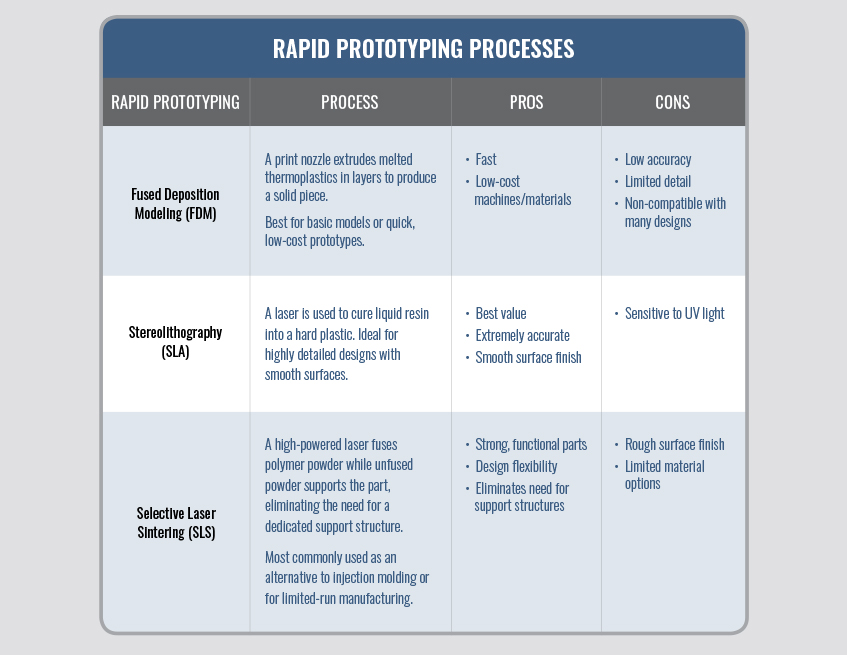
However not till the advancement of real strong modeling could ingenious processes such as RP be developed. Charles Hull, who assisted discovered 3D Systems in 1986, developed the very first RP procedure. This procedure, called stereolithography, develops things by treating thin consecutive layers of specific ultraviolet light-sensitive liquid resins with a low-power laser.
Indicators on What is Rapid Prototyping with 3D Printing? - Stratasys You Need To Know
The technologies referred to as Solid Freeform Fabrication are what we acknowledge today as fast prototyping, 3D printing or additive manufacturing: Swainson (1977 ), Schwerzel (1984) dealt with polymerization of a photosensitive polymer at the intersection of two computer managed laser beams. Ciraud (1972) considered magnetostatic or electrostatic deposition with electron beam, laser or plasma for sintered surface area cladding.
Hideo Kodama of Nagoya Municipal Industrial Research Study Institute was the first to publish an account of a strong model produced using a photopolymer fast prototyping system (1981 ). The extremely first 3D fast prototyping system counting on Merged Deposition Modeling (FDM) was made in April 1992 by Stratasys however the patent did not provide up until June 9, 1992.